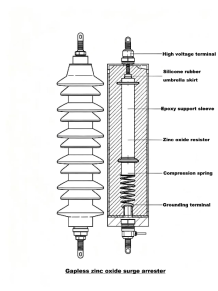
Practical Guide | A Minute to Understand Arresters
In power distribution systems, lightning surges and switching overvoltages constantly threaten the insulation of equipment such as voltage transformers, transformers, and switch cabinet. Arresters act as "safety guards" for electrical equipment.
The core function of a arrester is to limit grid overvoltage by diverting abnormally high voltages caused by lightning strikes or switching operations into the ground, thereby protecting the insulation of primary equipment such as transformers, circuit breakers, and cables from breakdown. During normal operation, it acts like an insulator and does not interfere with the normal functioning of the system.
Working Principle: The mainstream zinc oxide surge arrester contains zinc oxide varistors inside, which exhibit unique nonlinear characteristics: under normal power frequency voltage, resistance is extremely high, allowing almost no current to pass; when overvoltage occurs, resistance drops sharply, rapidly discharging lightning current; once the overvoltage disappears, the arrester immediately returns to its high-resistance state, automatically cutting off follow-up current.
Main Advantages
1. Gapless structure, fast response, stable protection performance;
2. High current-carrying capacity and low residual voltage, offering better protection than traditional silicon carbide surge arresters;
3. Simple structure and compact size, suitable for installation in indoor switch cabinet, outdoor lines, and pad-mounted substations;
4. Reliable operation with minimal maintenance requirements.
Application Scenarios
Widely used in 10kV/35kV switch cabinet, ring main units, and pad-mounted substations, often integrated with voltage transformers and vacuum circuit breakers, surge arresters are essential overvoltage protection devices in distribution systems.