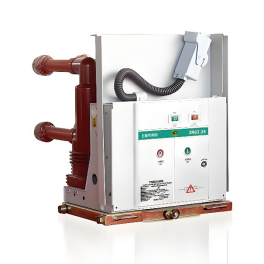
Advantages and Disadvantages of Vacuum Circuit Breakers
Vacuum circuit breakers rely on vacuum as the arc-quenching medium and are primarily used in 10kV to 40.5kV distribution systems. They are widely integrated into switch cabinet and often used in conjunction with current transformers.
I. Advantages
1. Excellent arc-quenching performance and high insulation strength
The vacuum chamber achieves extremely high vacuum levels, enabling rapid arc extinction and strong breaking capacity; insulation performance degrades minimally even after multiple operations.
2. Safe and reliable with low fire risk
Oil-free design prevents the generation of flammable gases or vapors, eliminating risks of explosion or oil spray fires; significantly safer compared to oil circuit breakers.
3. Strong environmental adaptability
No toxic gases are produced, and performance is hardly affected by altitude or humidity; free from fire danger, suitable for indoor switchrooms, new energy substations, and industrial/mining facilities.
4. Long mechanical and electrical life with minimal maintenance
Fast arc extinction reduces contact erosion, allowing frequent operation; no need to replace arc-quenching media during routine use, resulting in extended maintenance intervals.
5. Fast interruption capability
Short arcing time enables quick isolation of short-circuit faults, effectively protecting downstream equipment such as transformers, current transformers, and cables.
6. Compact structure and small footprint
Smaller in size at the same voltage level, facilitating modular installation in withdrawable switch cabinet and ring main units.
II. Disadvantages
1. Prone to operational overvoltage
The extremely fast arc quenching can generate chopping overvoltage when interrupting inductive loads (e.g., motors, reactors, unloaded transformers), potentially damaging transformer windings and insulation; surge arresters or RC snubber circuits are typically required.
2. Vacuum bubble cannot be visually inspected
The vacuum interrupter is hermetically sealed, making internal vacuum conditions impossible to assess by eye; aging and potential vacuum leakage over time are difficult to detect early, requiring periodic testing.
3. Difficult to repair once the interrupter fails
If the vacuum chamber leaks or contacts burn out, on-site repairs are not possible—replacement of the entire interrupter unit is necessary, leading to higher repair costs.
4. Higher cost than air circuit breakers and simple load switches
Initial procurement cost is higher than that of comparable gas-producing or air-type switches.
5. Not suitable for ultra-high voltage applications
High-voltage (110kV and above) vacuum circuit breakers are technically challenging and costly to manufacture; SF6 circuit breakers remain dominant in ultra-high voltage applications.